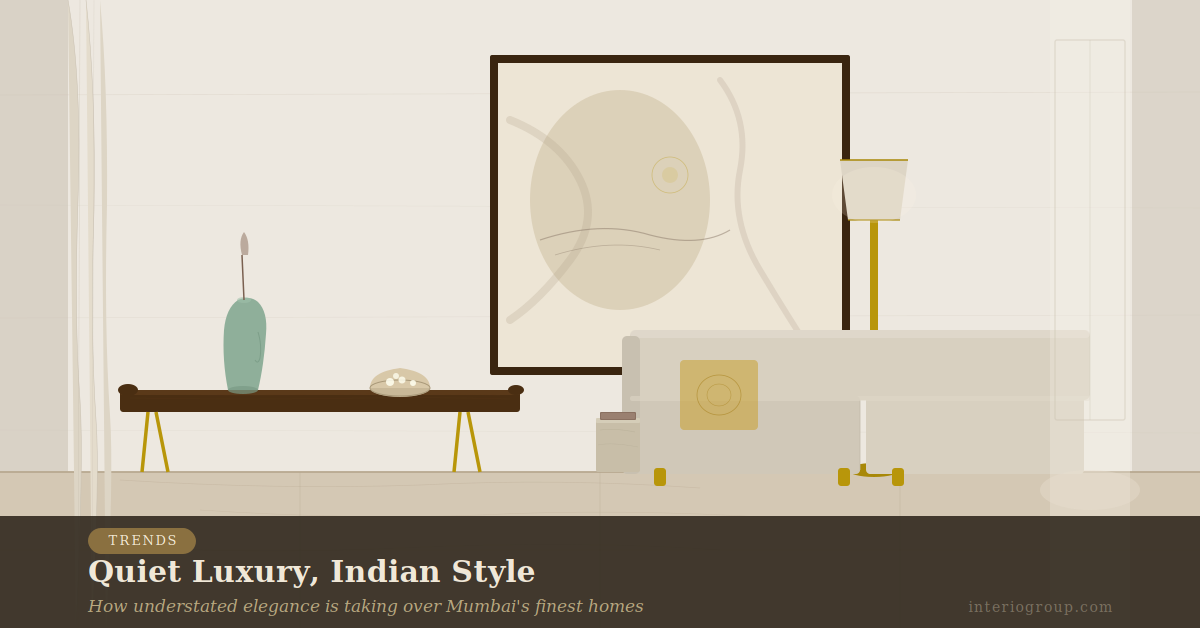
Quiet Luxury, Indian Style
There are no chandeliers fighting for attention here. No gold-veined marble competing with mirrored ceilings. No furniture chosen to impress guests who will stay for an hour. The most coveted new interiors in Mumbai’s finest addresses — the sea-facing apartments in Worli, the heritage-lane homes in Malabar Hill, the sleek towers rising along Bandra’s skyline — share a quieter language. Travertine floors that whisper underfoot. Linen curtains that filter the Arabian Sea light into something amber and gentle. A single hand-thrown ceramic bowl on a console of solid walnut. A painting chosen not for its price tag but for the way it changes at dusk.
This is quiet luxury, Indian style — and it is redefining what it means to live beautifully in India’s most aspirational city.
What Is Quiet Luxury Interior Design?
The idea of quiet luxury interiors revolves around elegance expressed through simplicity, natural materials, and subtle refinement rather than bold visual statements. Instead of flashy décor, this trend prioritises craftsmanship, timeless forms, and calming palettes built around warm neutrals and soft earth tones. High-quality finishes, refined textures, and carefully selected pieces create homes that feel elevated yet effortless.
It focuses on understated elegance, neutral tones, and high-quality materials rather than bold and flashy designs. Instead of excessive decoration, homeowners are choosing furniture that speaks through craftsmanship and subtle details. This trend creates a calm and sophisticated environment, making homes feel luxurious without being overwhelming.
The philosophy is summarised elegantly by one of its central premises: luxury now focuses on quality, subtle elegance, and timeless materials rather than flashy decor. In Mumbai — a city that has always equated aspiration with visibility — this is a significant cultural shift.
Why Mumbai Is Quiet Luxury’s Most Natural Home
Mumbai is India’s most expensive real estate market, and in 2026 its premium segment is in exceptional health. Demand for luxury residential projects in Mumbai has risen by 11–20%, driven by rising wealth, NRI investment, and new metro connectivity. Ultra-luxury projects in South Mumbai, Bandra, and Worli have seen strong sales, with unit prices exceeding ₹10 crore.
Luxury flats in Mumbai usually start from around ₹4–5 crore in upper-premium micro-markets and can go above ₹20–80 crore in ultra-luxury sea-facing projects. At these price points, the homeowner has moved decisively past the need to impress. What they want now is refinement — spaces that feel like the best version of calm.
South Mumbai remains the most iconic luxury locale in India, known for heritage, sea views, exclusivity, and high property values. Malabar Hill is India’s most prestigious address with sea views and exclusive homes, while Worli has emerged as a premier choice for affluent buyers seeking contemporary luxury in a connected location.
Luxury interior design has become one of Mumbai’s fastest-growing lifestyle sectors. Rising incomes, global exposure, premium real estate developments, and changing lifestyle aspirations are driving demand for personalised luxury homes. Modern homeowners no longer want generic interiors. They seek homes that express individuality, sophistication, and comfort.
This is precisely the audience quiet luxury speaks to: globally travelled, culturally confident, done with ostentation, ready for meaning.
The Quiet Luxury Palette: Colours That Whisper
Colour is where quiet luxury makes its most powerful statement — through restraint. A curated palette defines modern luxury: sandstone beige adds warmth, mushroom grey introduces sophisticated depth, mineral green brings an organic touch, and oyster white keeps spaces bright yet serene. These hues fit perfectly within quiet luxury home design because they provide richness without overwhelming the room.
In Mumbai’s context, this palette has an additional dimension. Homeowners are gravitating towards ‘Sonnet’ and ‘Conch Shell’, which create a soothing ambience perfect for Mumbai’s evolving interiors. Against the city’s relentless pace and brilliant coastal light, these tones become something more than neutral — they become restorative.
No ostentatious chandeliers. No feature walls vying for attention. Imagine elegant pieces of furniture with well-thought-out designs and clear, sophisticated lines — soft colours of ivory, antique bronze, and sage. This is the interior equivalent of a Loro Piana cashmere coat: nothing shouting, everything speaking.
For Indian homes specifically, the quiet luxury palette finds its most expressive moment when anchored by one carefully chosen warm accent — a burnished brass lamp, a single terracotta-glazed vase, a hand-embroidered silk cushion in barely-there saffron. It is the Indian edit of the aesthetic: neutral foundations with a whisper of cultural heritage.
Materials: Where Quiet Luxury Earns Its Name
If colour is the voice of quiet luxury, materials are its character. The foundation of luxury materials in interior design lies in natural finishes that mature gracefully. Soft-veined marble, light travertine, and honed limestone are signature elements of quiet luxury interiors in 2026. These stones carry a geological depth that manufactured surfaces cannot replicate.
The palette leans toward earthy neutrals and muted tones, while texture becomes the new status symbol. Materials like linen, stone, brushed metal, and wood are chosen for their quality and how they will age over time. This approach aligns well with the growing emphasis on sustainable living. Rather than buying more, homeowners invest in fewer, better things — solid furniture that can be repaired, timeless finishes that don’t date quickly, and handcrafted pieces with a story to tell.
In Mumbai’s premium apartments, this translates into specific choices that are becoming signatures of the quiet luxury home:
- Travertine: Used for flooring, bathroom walls, and even kitchen counters in their honed, matte finish — never polished.
- Solid teak and walnut: Furniture with visible, honest grain; no veneer, no lacquer.
- Undyed linen: Curtains, upholstery, and bed dressings in their natural, unprocessed colour.
- Brushed brass: Not the shiny gold of the last decade, but aged, matte, patinated — handles, taps, light fittings.
- Handmade ceramics: Tableware and decorative objects in stoneware glazes of celadon, ash, and warm white.
- Natural stone: Bathroom counters in Jodhpur sandstone or Kerala white granite in their most raw, honed state.
Designs feature clean lines, natural materials, and plush fabrics. This approach focuses on quality over quantity. It creates a serene atmosphere where every element adds to the overall elegance.
The Indian Dimension: Quiet Luxury Meets Heritage Craft
What distinguishes the Indian interpretation of quiet luxury from its Western counterpart is the invisible thread of craft that runs through it. A European quiet luxury home might feature Murano glass and Viennese furniture. An Indian quiet luxury home features something far more resonant: a handwoven Kanchipuram silk cushion in barely-there gold. A Chettinad teak console, centuries-old in its joinery technique. A brass *urli* bowl from Kerala, set on a marble plinth, filled with floating jasmine.
Homeowners in 2026 are redefining luxury. They prefer curated, meaningful environments over flashy displays. They mix design trends with classic beauty. In Mumbai specifically, this means blending the international language of quiet luxury with objects that carry deep cultural provenance — not as nostalgia, but as identity.
It’s all about creating interiors that don’t shout, but rather whisper their luxury through subtlety and understatement. Quiet luxury in India whispers in two languages simultaneously — the global language of refined restraint, and the distinctly Indian language of inherited craft and cultural memory.
This fusion gives Indian quiet luxury homes a warmth that pure Western minimalism can never quite achieve. They feel lived in, personal, grown from real life — not assembled from a mood board.
Room by Room: Quiet Luxury in the Mumbai Home
The Living Room
The quiet luxury living room in Mumbai begins with a palette: warm white walls in a matte finish, a travertine coffee table, a sofa in undyed natural linen. From there, layers build slowly — a hand-knotted wool rug in mushroom and ivory, one large-scale painting by an Indian contemporary artist, a console in solid walnut with a single sculptural object on its surface. No clutter. No duplicated function. Every detail is carefully curated to create a cohesive atmosphere. High-end interiors use refined materials that offer durability and sophistication.
The Primary Bedroom
In this approach, the home turns into a serene retreat where every detail feels intentional, understated, and refined. This is the true essence of luxury in 2026 — calm, authentic, and deeply inviting. The quiet luxury bedroom is almost meditative: a low platform bed in solid wood with a linen headboard, bedside tables in honed stone, blackout curtains in barely-there grey that pool gently on the floor. No television visible. No phone charger on display. Just stillness, designed.
The Bathroom
Mumbai’s finest quiet luxury bathrooms read as spas: fluted travertine walls, a freestanding stone basin, matte black or brushed brass taps, generous natural light, and a single deep-soaking tub positioned to catch the view. Subtle yet striking elements — like incorporating gold or brass finishes in furniture such as door openings or table frames — add a touch of understated opulence.
The Kitchen
The quiet luxury kitchen hides rather than displays. Handleless cabinetry in warm putty or smoke grey, stone counters in honed finish, appliances concealed behind cabinetry panels. The only objects on display: a single hand-thrown ceramic pot, a small arrangement of dried botanicals, a wooden chopping board of obvious quality. Everything else — everything — behind closed doors.
Quiet Luxury vs. Cold Minimalism: A Critical Distinction
Many confuse quiet luxury with the stark minimalism that defined interiors of the early 2010s. They are different in one essential way: warmth.
Quiet luxury has always been about calm confidence, but in 2026 it becomes more human. It’s less about perfection and more about creating spaces that feel good, look timeless, and tread lightly on the planet.
Cold minimalism removes until nothing remains. Quiet luxury removes until only what is meaningful remains — and what remains is always warm, tactile, and human. A quiet luxury home has a candle. It has a book left open on the coffee table. It has a worn linen cushion that has been washed many times. It has a faint smell of sandalwood or vetiver. It feels like the most expensive version of comfort — not the most expensive version of performance.
The Sustainability Dimension
The future of luxury furniture in India is centred around sustainability, smart technology, and personalisation. Designs will continue to become more functional and minimal while maintaining elegance. As consumer preferences evolve, the focus will remain on creating spaces that are comfortable, meaningful, and visually appealing. Today’s luxury is not about excess but about balance, quality, and experience.
Quiet luxury and sustainability are natural allies. When you buy fewer, better things — a solid teak table instead of five flat-pack ones — you are both investing in craftsmanship and reducing waste. When you choose natural materials that age beautifully, you are building interiors that will not need to be replaced in five years. This resonates powerfully with a new generation of Mumbai homeowners who have grown up with an environmental awareness their parents did not have.
How to Bring Quiet Luxury Into Your Mumbai Home
You do not need a Worli sea-view apartment to adopt this philosophy. Quiet luxury is a mindset applied to your existing space:
Edit ruthlessly. Remove everything that is not beautiful or useful. What remains is your starting point.
Invest in one extraordinary material.A honed stone countertop. A solid wood dining table. A handmade ceramic collection. Quality over quantity, always.
Neutralise your palette. Paint walls in warm white, soft mushroom, or barely-there sage. Allow the materials — the wood, the stone, the linen — to carry the visual interest.
Replace shine with texture. Swap polished chrome for brushed brass. Replace glossy tiles with honed stone. Choose matte paint over eggshell. The quieter the sheen, the more luxurious the result.
Introduce one piece of authentic Indian craft.A handwoven textile, a hand-thrown ceramic, a piece of contemporary Indian art — this is what separates Indian quiet luxury from its international counterpart, and it is what makes it matter.

Harish Yadav is the founder of Interio Group App. It is an Home-Interiors Marketplace where customers can hire Interior businesses and designers directly. Customers can get quotes for their interior needs.