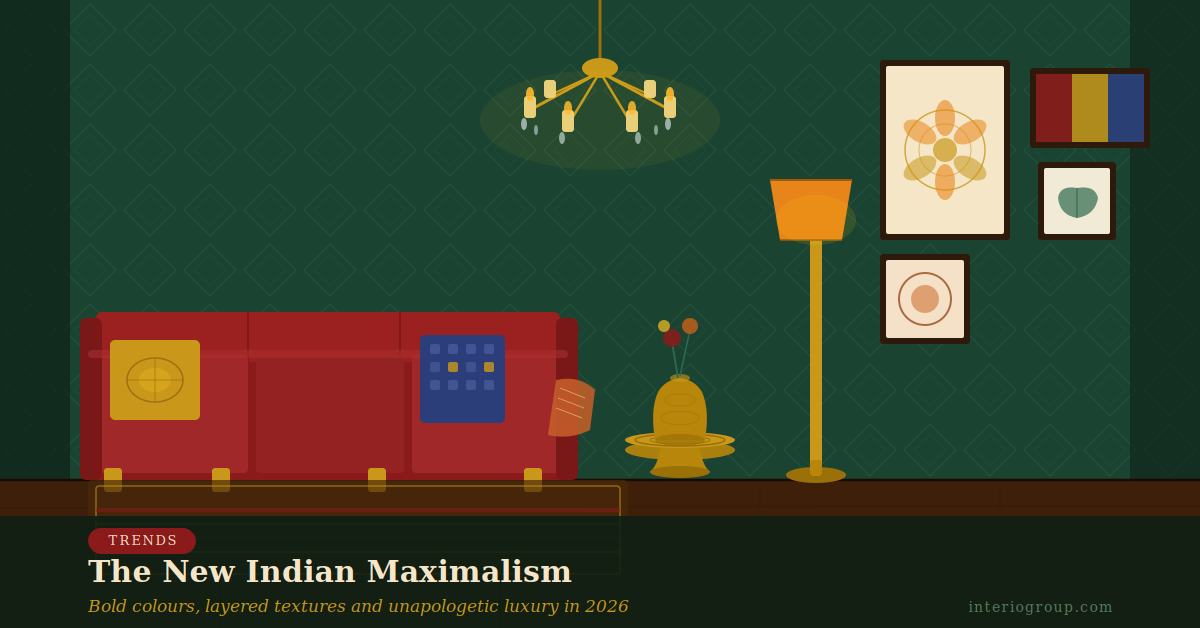
The New Indian Maximalism
Walk into the most exciting new homes being designed across Mumbai, Delhi, Hyderabad and Bangalore right now, and you will notice something has shifted. Gone is the reign of all-white walls, grey modular kitchens and imported Scandinavian furniture that dominated the 2010s. In their place: deep cardinal reds paired with aged brass. Walls drenched from floor to ceiling in forest green. Hand-embroidered silk cushions stacked unapologetically against velvet upholstery. Antique furniture placed next to contemporary art. India’s interiors are getting bold — and they are doing it on their own terms.
This is the New Indian Maximalism. Not the cluttered excess of the past, but a confident, curated, culturally rooted approach to decoration that says: more is more, as long as every piece means something.
What Is the New Indian Maximalism?
Indian maximalism is not a new concept — it is a homecoming. Traditional Indian homes have always featured bold hues like deep reds, royal blues, and warm yellows, combined with intricate patterns drawing from nature, mythology, and regional crafts. This visual richness is not random — it reflects India’s diverse cultural landscape, where each region contributes its own artistic language, from Rajasthani mirror work to Kashmiri wood carving, from Madhubani paintings to South Indian temple motifs.
What makes 2026’s version distinct is the layer of contemporary restraint applied to this abundance. In contemporary design, maximalism is being rediscovered and reinterpreted. Urban Indian homes are blending traditional elements with modern sensibilities, creating spaces that are both vibrant and balanced. Designers are experimenting with controlled maximalism, where bold elements are curated thoughtfully to avoid overwhelming the space.
The result is something that feels neither nostalgic nor imported — it feels Indian, in the deepest and most current sense of the word.
Why Indian Maximalism Is Surging in 2026
The numbers tell a compelling story. The India Interior Design Market is worth USD 35.48 billion in 2026 and is growing at a CAGR of 12.87%, projected to reach USD 65.01 billion by 2031. Within this surging market, the luxury and premium residential segment is where the boldest design choices are being made — and maximalism is at its core.
Several forces have converged to make this moment possible:
1. The Tax Relief Effect. The 2025–26 Union Budget waived income tax on annual incomes up to ₹12 lakh under the new regime, redirecting a meaningful share of household discretionary budgets toward premium home upgrades. More disposable income means more willingness to invest in statement interiors.
2. The Renovation Acceleration. Renovation cycles have shortened to 10–12 years, from 15–20 historically, reflecting a structural craving for contemporary aesthetics. Indians are redesigning their homes faster — and with greater confidence and ambition each time.
3. The Rejection of Borrowed Minimalism. If 2025 was about perfection, then 2026 is about meaning. After years of curated minimalism and visual discipline, homes are beginning to loosen their collars — becoming warmer, more expressive, and deeply personal. The cold greys and stark whites that once dominated are now being swept aside.
4. The Identity Assertion. In modern India, designs are not just aesthetic but a statement of identity. A generation that grew up watching interiors defined by Western imports is now choosing to furnish their homes with a fierce sense of cultural pride.
The Colour Palette of the New Indian Maximalism
Colour is the first language of maximalism — and in 2026, India is speaking it loudly.
Bold colours are back, but they are smarter this time around. Cardinal Red has beautiful velvety undertones that add warmth and luxury without shouting for attention — pair it with gold accents or deep grays and it creates an elegant confidence that works perfectly in Indian homes. Deep blues like indigo, midnight blue, and teal have become go-to choices for accent walls.
Indian homes frequently use bold colours like maroon, royal blue, bright yellow, and emerald green, inspired by nature and traditional elements. Colours such as saffron represent courage, while green is often associated with festivity. These are not arbitrary choices — they carry centuries of cultural meaning that maximalism allows to be worn proudly.
In 2026, colour reflects a gentle optimism: ochres, olive greens, mustard yellows, and softened terracottas — warm, sun-faded palettes that carry something inherently hopeful.
The key distinction from maximalism of a decade ago? The palette is curated. The room still follows a visual system: one dominant colour, one supporting colour, and a limited number of accents. Bold upholstery, artwork or a colour-blocked wall can create the main focal point — when every object competes equally for attention, the result feels chaotic rather than joyful.
Texture: The Secret Weapon of Indian Maximalist Interiors
If colour is the headline, texture is the depth that makes maximalism feel rich rather than overwhelming. In the New Indian Maximalism, surfaces compete beautifully for the fingertips.
Spaces gain depth and intrigue from ornate plaster finishes, wood panelling and wallpapered ceilings. Natural materials such as stone, wood and clay create a sense of tranquility and connection with nature even within a maximalist scheme.
This layering of textures is deeply rooted in Indian craft: carved teak panels alongside handwoven Ikat upholstery; a Kantha-stitched throw over a velvet sofa; a Jaipur hand-knotted rug beneath a contemporary glass coffee table. Each layer references a tradition while the whole composition reads as unmistakably modern.
The biggest trends for 2026 include artisan maximalism celebrating handcrafted pieces, where the emphasis is on rich textures, artisan objects and curated layers rather than mere clutter.
The Art of Controlled Maximalism: Rules to Live By
The difference between a maximalist home that sings and one that overwhelms comes down to intention. India’s best designers follow a clear set of principles:
Choose a Visual Anchor
Every maximalist room needs one dominant element that commands attention — a floor-to-ceiling bookcase in deep teal, a hand-painted statement wall, or a chandelier of extraordinary scale. Everything else in the room responds to this anchor rather than competing with it.
Honour the Colour Triangle
Follow a visual system: one dominant colour, one supporting colour, and a limited number of accents. In practice for Indian homes, this might mean: deep indigo walls (dominant), natural cane furniture (supporting), and brass and hand-embroidered textile accents (accent). Three voices, one conversation.
Layer Patterns With Purpose
Patterns are maximalism’s greatest joy — and greatest risk. The rule is simple: vary scale. A large geometric block-print on the curtains can coexist with a small floral on the cushions and a medium-scale stripe on the rug, as long as they share at least one colour from the same palette.
Mix Eras, Not Chaos
One meaningful restored heirloom can contribute more character than a room filled with newly manufactured “vintage” objects. The New Indian Maximalism thrives on genuine age — a brass kalash from three generations ago placed next to a contemporary sculpture.
Give the Eye a Resting Place
Even in the boldest room, there must be moments of visual quiet — a plain plastered wall section, a bare wooden floor, a simple unadorned window. These pauses make the bold moments more powerful, not less.
Room by Room: How to Apply New Indian Maximalism
Living Room: This is where maximalism earns its keep. When integrating bold colours into home design, maintaining balance is crucial. Opt for bold accent walls in common areas and mix hues with neutral tones to ensure a cohesive and aesthetically pleasing environment. A deep jewel-toned sofa, gallery walls of mixed Indian art and photography, layered rugs, and a collection of brass objects on a carved sideboard — this is the language.
Bedroom: The maximalist Indian bedroom is not a showroom — it is a sanctuary that happens to be deeply beautiful. Think: a four-poster bed dressed in embroidered quilts, bedside tables from two different periods in complementary woods, a statement pendant in wrought iron, and curtains in hand-block-printed cotton from floor to ceiling.
Kitchen: Textured walls, fluted panels, patterned tiles, and handcrafted décor pieces inspired by Indian artistry add depth and personality to interiors. In the maximalist kitchen, this means hand-painted Moroccan or Portuguese-inspired tiles on the backsplash, open shelving displaying a curated collection of handmade pottery and copper vessels, and cabinet colours that are anything but safe.
Dining Room: Nowhere is Indian maximalism more at home than the dining space. A carved wooden table, mismatched chairs in the same colour family, a chandelier that makes a statement, and a sideboard dressed with a brass collection — this is where the style reaches its fullest expression.
Indian Maximalism vs. Its Predecessors: A Clear Evolution
| Era | Style | Character |
| 2000s–2010s | Traditional Indian | Ornate, regional, inherited |
| 2012–2020 | Import Minimalism | White walls, grey tones, Western catalogue |
| 2020–2023 | Boho-Indian | Cane, macramé, earthy but undisciplined |
| 2024–2026 | New Indian Maximalism | Bold, curated, craft-led, culturally rooted |
Several trends are becoming oversaturated: all-grey interiors are losing ground to warmer tones, overdone boho aesthetics are giving way to more refined looks, and high-gloss gold and mirror finishes are being replaced by brushed, aged metals. People want homes that feel lived in and authentic, not styled for a photoshoot.
The Designers Leading the New Indian Maximalism
India’s most celebrated interior designers are not decorating — they are composing. Studios like Minnie Bhatt Design are championing the use of bold colour without apology. “For people who enjoy maximalist or whimsical interior design, who wish to create a statement, or want to add a stylish touch to their surroundings, it is time to be unafraid of colours,” says Minnie Bhatt, Founder and Design Director at Minnie Bhatt Design.
Others are drawing from regional craft to build maximalist palettes rooted in Indian material heritage — Pichwai paintings on raw plaster walls, Banaras brocade curtains in rooms furnished with clean-lined contemporary furniture, Ettore Sottsass-inspired colour blocking in homes where every shelf tells a story.
How to Start Your Indian Maximalist Journey
You do not have to redesign your entire home to embrace maximalism. Begin with a single room — ideally the one you spend the most time in. Follow these first steps:
- Pick your dominant colour — something that makes your heart lift when you imagine being surrounded by it
- Commission or source one statement craft piece — a hand-knotted rug, a ceramic lamp, a block-printed wall hanging.
- Layer with inherited objects — bring out what has been in storage and give it pride of place.
- Add pattern to one textile — a cushion, a throw, or a curtain in a bold Indian print.
- Hang art, and hang it generously — a gallery wall is maximalism’s great democratic tradition
The Future of Indian Maximalism.
As people look for spaces that feel personal, maximalism is set to become a lasting trend — resonating strongly as it draws attention towards one’s individuality and creativity. In India’s case, it also draws on something deeper: a design tradition that was never truly minimalist, a cultural vocabulary that has always spoken in colour and pattern, and a generation of homeowners confident enough to finally let it show.
The New Indian Maximalism is not a trend imported from a Western mood board. It is India’s design culture looking in the mirror — and liking very much what it sees.
Key Takeaways
- The New Indian Maximalism is bold, curated, and culturally rooted — distinct from both Western maximalism and clutter-driven excess.
- India’s interior design market reached USD 35.48 billion in 2026, growing at 12.87% CAGR, with luxury residential leading.
- The colour palette is led by cardinal red, deep indigo, forest green, mustard, and saffron — all with strong cultural significance.
- Controlled maximalism follows rules: one dominant colour, varied pattern scales, mixed eras, and moments of visual rest.
- The movement is a rejection of imported minimalism in favour of authentic, craft-driven Indian expression.

Harish Yadav is the founder of Interio Group App. It is an Home-Interiors Marketplace where customers can hire Interior businesses and designers directly. Customers can get quotes for their interior needs.