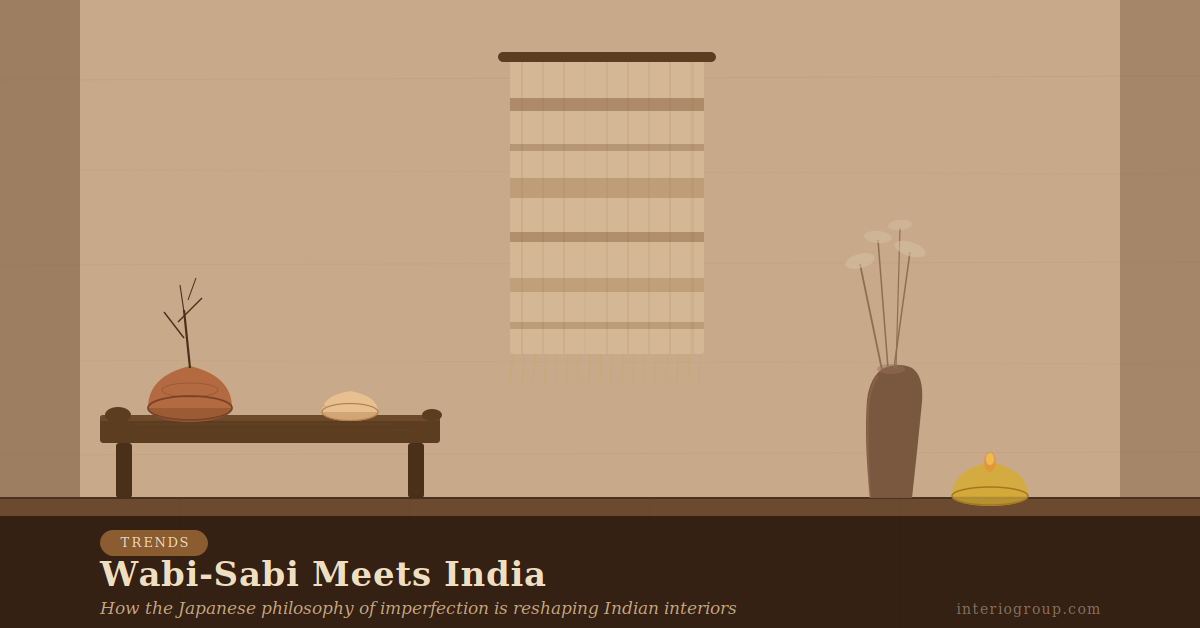
There is a quiet revolution happening inside Indian homes. Not loud, not ornate, not Instagram-showroom-perfect — but deeply intentional. Walls are left with visible plaster strokes. Furniture bears the honest grain of solid teak. Pottery sits chipped at the rim, beloved rather than discarded. This is Wabi-Sabi, the ancient Japanese philosophy of finding beauty in imperfection, and it is reshaping the way India’s most thoughtful homeowners are choosing to live.
In a country where interiors have long swung between the ornamental excess of traditional décor and the cold precision of imported minimalism, Wabi-Sabi feels like a revelation — and yet, somehow, like coming home.
What Is Wabi-Sabi Interior Design?
The term Wabi-Sabi comes from two Japanese concepts: wabi, meaning rustic simplicity and quiet contentment, and sabi, meaning the beauty that comes with age and use. Together, they form a philosophy that finds elegance in the impermanent, the incomplete, and the imperfect.
In interior design terms, Wabi-Sabi means:
- Textured, handcrafted surfaces over smooth, manufactured finishes
- Muted, earthy colour palettes — clay, sand, charcoal, warm white, moss green
- Natural materials — raw stone, reclaimed wood, unbleached linen, handmade ceramics
- Asymmetry and irregularity rather than rigid symmetry
- Fewer, more meaningful objects rather than decorative abundance
Unlike sterile minimalism, which can feel cold and performative, Wabi-Sabi interiors feel inhabited. They have a pulse. They tell the story of the people who live within them.
Why Wabi-Sabi Is Having Its Biggest Moment in India Right Now
India’s interior design industry is in a period of extraordinary growth. According to IMARC Group, the market was valued at USD 36.89 billion in 2025 and is projected to reach USD 74.73 billion by 2034, growing at a CAGR of 8.16%. Alongside this expansion, a more discerning consumer has emerged — one who is tired of cookie-cutter modular kitchens and imported-catalogue living rooms.
Searches for “Wabi-Sabi wall decor” surged by 90% according to 2025 trend data from global design agencies, signalling a widespread shift away from mass-produced perfection toward authenticity and emotional connection.
But the real reason Wabi-Sabi resonates so powerfully in India is cultural. The philosophy resonates deeply in Indian homes where people have always valued the patina of age and the stories behind inherited pieces. Think of the brass handi passed down from a grandmother, the hand-knotted durrie that has faded beautifully over three decades, the teak sideboard whose scratches map decades of family dinners. Wabi-Sabi doesn’t ask Indian homeowners to discard their history — it asks them to honour it.
“In 2025, we’re seeing a shift from sterile minimalism to soul-filled minimalism. People want homes that breathe.” That sentiment rings especially true in India’s metros, where the pace of life — and the relentless pressure toward the new — has created a genuine hunger for spaces that feel grounded and real.
The Indian-Wabi-Sabi Connection: It Was Never Foreign
What is remarkable about Wabi-Sabi in the Indian context is how little translation it requires.
India has always had its own philosophies of imperfection and mindful living. The concept of Jugaad celebrates resourceful improvisation. Vastu Shastra grounds architecture in nature. The tradition of antique charm — buying furniture at Chor Bazaar in Mumbai or the Sunday markets in Delhi — has always been about finding beauty in the aged and the worn.
The growing interest in Wabi-Sabi interior design has introduced many people to the idea that a chipped bowl or a faded fabric can hold more beauty than something flawless — a notion that Indian grandmothers have quietly understood for generations.
Indian pottery traditions are inherently aligned with Wabi-Sabi, as each piece is handmade, unique, and slightly imperfect. Consider Bishnupur Terracotta from West Bengal, known for its deep reddish-brown hue that adds warmth and texture. Or Khurja Clay from Uttar Pradesh — hand-painted with simple patterns, ideal for vases and planters. These are not imitations of a Japanese aesthetic. They are its natural Indian counterpart, waiting to be seen through a new lens.
How Indian Designers Are Interpreting Wabi-Sabi
India’s design community has embraced Wabi-Sabi not as a wholesale import but as a framework for doing what Indian design does best: combining global sensibility with local material.
In Kolkata, studios have designed Japandi-Wabi-Sabi hybrid homes where terrazzo floors with organic curved motifs anchor spaces furnished with handwoven textiles and raw-edged wooden furniture. Drawing on the Wabi-Sabi philosophy — finding beauty in imperfection and authenticity — these homes celebrate restraint and purpose in every detail, with natural materials, tactile finishes, and uncluttered spatial flow.
In Bangalore, designers are using lime-wash paint in soft clay and stone hues to create an aged-but-elegant backdrop — walls that seem to have always been there, breathing quietly behind the furniture. In Mumbai, compact apartments are being redesigned around a single beautiful imperfect object: a live-edge wood console, a hand-thrown pot that doesn’t sit quite level, a woven cotton throw in undyed natural fibre.
India’s rich tradition of artisanal craftsmanship, natural materials like teak and marble, and the reverence for objects that carry history makes Wabi-Sabi a natural fit for Indian homes.
How to Bring Wabi-Sabi Into Your Indian Home: A Practical Guide
You do not need to gut your home to adopt this philosophy. Wabi-Sabi is a mindset before it is a material list. Here is how to begin:
1. Start With the Walls
Move away from high-gloss paints. Use textured plaster, lime-wash, or clay-based finishes in warm neutrals — sand, off-white, warm grey, or pale terracotta. Allow brushstrokes to be visible. The imperfection is the point.
2. Choose Furniture That Ages Gracefully
Wabi-Sabi interiors are built on materials that age gracefully — solid wood, natural stone, linen, cotton, wool, and ceramics. In an Indian context, this means choosing furniture crafted from solid teakwood rather than engineered boards. Look for pieces with visible grain, natural variations, and honest joinery.
3. Curate, Don’t Accumulate
Wabi-Sabi is allergic to clutter — but it is not minimalism for minimalism’s sake. Choose five meaningful objects over fifty decorative ones. A single hand-thrown vase from a Rajasthani artisan. A worn silk cushion in muted indigo. A brass lamp that has oxidised to a beautiful dark patina.
4. Layer Natural Textiles
Undyed cotton, raw linen, handwoven jute — these are the textiles of Wabi-Sabi. Indian homes are already rich in handloom traditions: Chanderi, Maheshwari, Khadi. Use them as throws, curtains, and upholstery in their most natural, unprocessed state.
5. Bring In Handmade Ceramics
Incorporate handmade pottery, handwoven baskets, and asymmetrical vases to bring tactile beauty into your space. India’s craft traditions — from Kutch to Khurja — produce pottery that is inherently Wabi-Sabi. Display it, use it, and let it age.
6. Honour Inherited and Aged Pieces
Do not replace your grandmother’s wooden cupboard with a flatpack wardrobe. Restore it, polish it with natural oil, and place it at the centre of a room. The wear it carries is not a flaw — it is a record of lives lived.
Wabi-Sabi vs. Minimalism: Understanding the Difference
The two are often confused, but they are fundamentally different in spirit. Minimalism removes until nothing remains except form. Wabi-Sabi removes until only what is meaningful remains — and then lets those things show their age, their texture, their human origin.
Minimalism can feel like a showroom. Wabi-Sabi always feels like a home.
Instead of highly polished, uniform rooms, designers are exploring Wabi-Sabi textures, biophilic planning, regional materials, multifunctional layouts, artisan craftsmanship and discreet technology — especially relevant in India, where compact apartments, multigenerational living, varied climates and regional craft traditions shape design decisions.
The Wellness Dimension: Why Imperfect Homes Feel Better to Live In
There is growing evidence that the environments we inhabit directly affect our mental health. Overly curated, perfectly symmetrical spaces can create a low-level anxiety — the feeling that nothing must be touched, moved, or used. Wabi-Sabi interiors are designed to be used, to evolve, to gather the marks of daily life without losing their beauty.
For Indian homeowners in metro cities seeking peace amidst the noise, Wabi-Sabi offers more than a look — it offers a mindset. And when paired with Indian craftsmanship and reclaimed materials, it creates homes that are not only serene, but deeply personal.
In an era of social media perfectionism and curated digital lives, there is something profoundly liberating about a home philosophy that says: the crack in the plaster is beautiful. The worn edge of the table is beautiful. The slight lean of a hand-thrown pot is beautiful. You are beautiful, imperfect, and complete.
The Future of Wabi-Sabi in India
As India’s middle and upper-middle class continue to mature in their design sensibility — moving from aspiration toward authenticity — Wabi-Sabi is positioned not as a passing trend but as a lasting shift in values. Indian interiors in 2026 are becoming warmer, more natural, adaptable and personal. The strongest projects will not copy a trend literally — they will adapt its principles to the residents, architecture, location and long-term maintenance needs.
That, ultimately, is what makes Wabi-Sabi so well-suited to India. It does not ask you to copy Japan. It asks you to look more closely at your own home — at the things you already have, the materials that already surround you, the imperfections you already live with — and to see them, perhaps for the first time, as beautiful.
Key Takeaways
- Wabi-Sabi is a Japanese design philosophy that finds beauty in imperfection, age, and natural materials.
- India’s design market is growing at 8.16% CAGR — and the demand for authentic, craft-led interiors is driving Wabi-Sabi’s popularity.
- Indian craft traditions — from terracotta pottery to handloom textiles — are inherently aligned with Wabi-Sabi principles.
- Practical steps include textured wall finishes, solid wood furniture, handmade ceramics, natural textiles, and honouring inherited objects.
- Unlike cold minimalism, Wabi-Sabi creates homes that feel inhabited, warm, and deeply personal.

Harish Yadav is the founder of Interio Group App. It is an Home-Interiors Marketplace where customers can hire Interior businesses and designers directly. Customers can get quotes for their interior needs.